Wednesday, September 9, 2009

holy diversions batman!


There are very few places in the world like Jerusalem. The stereotype of the devoute practitioners of the three primary monothesite religons living together in the crowded morass of the Old City could not be more true. Catholic Nuns brush passed black-cloaked and fur-hatted Orthodox Jews, while the Muslim call to prayer rings out over the din of shopkeepers who seem to worship little more than the Almighty Dollar.

At the ninth station of the cross in Jerusalem.

Devin and I left for Jerusalem from Petra early Friday morning, concious of the interferance we would encounter with the approach of Shabbat. The seventh day of the Jewish Week, Shabbat lasts from sundown on Friday until sundown on Saturday, and this day of rest effectively closes down all public infrastructure in Israel. This includes the state-run bus system. So I was in a hurry to catch the last bus from Eilat, in southern Israel, north to Jerusalem. On the minibus from Petra to Aqaba, Devin informed me that after Eliot and I had gone to bed (at around 2:00) he had stayed up on the computer. Fighting exhaustion after spending the whole day in Petra, he switched around his flights so that rather than going from Eilat to Cairo and flying home, he would be coming with me, first to Israel and then to Nepal. Initially, I thought he was kidding - the whole thing did seem a bit implausible - but when I realized that he was serious I was thrilled at the prospect of having someone I already knew along to climb the Himalayas. So after leaving Jordan, the two of us made it to the Eilat bus station in time to catch the 10:30 bus, but were grieved to find it full. Fortunately, a bus was scheduled to leave at 14:00, and would be arriving in Jerusalem just before sunset.

After biding our time at the bus station, our bus finally arrived and Devin and I hoped onboard. The bus was comfortable, air condition, and an overall welcome relief from the public transportation of the Arab world (a more general statement of comparison might also apply). We drove through the desert and along the Dead Sea on our way north, passing salt flats and sink holes as we rode.

A mountain of salt pulled from the Dead Sea.

Reflections of the landscape through the dirty bus window.

As Devin and I had woken up at around 5:00 on two and three hours of sleep respectively, we dozed off for most of the trip, and before we knew it we were in Jerusalem. I was roused from my slumber by the urgent calls of the bus driver for everyone to get off the bus. A little dazed and confused, I hurriedly collected my belongings, and disembarked. Grabbing our luggage from underneath the bus, Devin and I were ushered away from the bus station, which was in the process of being locked down for Shabbat. Checking to see that I had everything with me, I was suddenly struck by a sickening realization: I didn't have my wallet. I knew instantly that I must have left it on the bus, and so I ran back to the service enterance we had be shown off at and informed the guard of my predicament.

Unfortunately, he did not speak any English, and I could not communicate what had happened. So I continued to run around the massive bus station until I came to another guard at another service entrance. He was much more helpful, but apparently with dozens of buses coming in to the Central Station, they had no way of identifying which bus I had just come in on. My balloon of hope was deflated when I was told that there was nothing more than could be done, however, the guard suggested I come back first thing Sunday morning to check with Lost & Found.

In the mean time, I reconnected with Devin, and the two of us set about trying to contact my friend Micaela. Micaela recently moved in to the Old City of Jerusalem, and she had offered us a place to crash during our stay. Unfortunately, we had placed too much of a reliance on my Egyptian Vodaphone as a means of contact, and attempts to call her number from public telephones proved equally unsuccessful. To keep from feeling overwhelmed by our sudden turn in luck, I reminded myself that there are plenty of hostels in Jerusalem, and it wasn't such a big deal to check into one. Devin and I walked around the Shabbat-barren city for a bit until I was able to find and pirate a wireless signal. I sent an eMail to Micaela, and also located a decent hostel. Flagging down a cab, Devin and I headed toward the Old City, following the directions posted by the hostel.

It would take a little adventure through the back alleyways of the Old City, but we eventually found the hostel. The man at the front desk was busy helping other guest, and I took advantage of his distraction to jump onto the computer to check my eMails. Luck seemed to be turning, as Micaela had replied and suggested that we meet up at the Damascus Gate and 19:30. I had just enough time to memorize this information, before being called over by the man at the front desk. Pretending that we had just stopped by to inquire about a future stay, we ducked out of the hostel and made our way to Damascus Gate. Just passed 19:30, I saw the welcome figure of Micaela appear out of the crowd, and after some breif introductions we were heading back to her place.

The view from Micaela's appartment in the Muslim Quarter.

As you can see, Micaela has a rather excellent view of the Old City from her appartment, and beyond its aestic advantageous, it helped me to orient myself. On our way up, we ran into some of Micaela's roommates who were on their way out to see the Western/Wailing Wall. While Micaela decided to stay behind, we went with her roommates to see the holiest site of the Jewish faith. The Western Wall wasn't hard to find, one simply had to follow the steady stream of Orthodox Jews cutting their way through the Muslim Quarter. Respecting the requests posted around the site, I refrained from taking pictures of the Western Wall, and instead dawned a cardboard yarmulke - provided near the entrance - and walked down to the men's side. The four walls of the temple, built by King Herrod of Biblical infamy, originally supported the now vanished Temple Mount. In this Holy of Holies, the Ten Commandments rested in the Arc of the Covenant approximately at the current location of the Dome of the Rock. The closest point to the resting place of the Arc and the Commandments is the short section of the Western Wall, and so for centuries, Jews have gathered in this place to pray and lament the loss of their Temple.

Experiencing this on the night of Shabbat was quite moving, and I did my best to be respectful of this holy occasion. We departed the Western Wall and made our way through the teeming streets of the Old City back to Micaela's apartment. There we found that she had prepared a scrumptious pasta dinner, and we all sat around the dining room table, enjoying the food and acquainting ourselves. Devin and I were still rather tired that day, so after staying up chatting for a while, we excused ourselves and headed off to bed. The next morning was the first morning in almost a week that we could sleep in, though my cicadian rhythm say fit to thwart this luxury.

After a delicous breakfast (which included my first cranberries since leaving New England) Miceala, her roommate Terez and her cousin, Devin, and I all headed out to the Church of the Holy Sepulchre. The most famous church in Jerusalem, Catholics believe the Church of the Holy Sepulchre to stand on top of the ancient Mt. Golgotha where Jesus Christ was crucified and buried. Over the centuries, the church has evolved into a labryth of catacombs and temples, and the resulting lack of uniformity makes it unlike any church or cathedral I have ever visited.

The faithful, praying at the spot where Catholics believe Christ was placed after comming off the cross.

A gold mosaic illustrating the Passion.

When we left the Church of the Holy Sepulchre, it was to regroup at Jaffa Gate where we joined a walking tour of the city. The tour was free, though generous tips to the guide are naturally expected, and we found it to be a fantastic, and reasonably inexpensive, overview of the Jerusalem. Our guide took us to every significant site in the Old City during the five hour tour, and made some suggestions as to other places we might want to stop by. Leaving a generous tip, the five of us made our way back to the appartment, where we met up with Micaela's other roommate. Now rounding out a half dozen, we left the Old City to find a recommended restaurant. Unfortunately, it was closed because of Ramadan, but we managed to find another place with good food and the best beer I've had since leaving Copenhagen.

After dinner, we picked up some local pastries and retired to the apartment, where we sampled the honey-drenched offerings with tea. I was the first to head off to bed, as I needed to be up the next morning at 4:45, that I might arrive at the bus station when it opened at 5:30. Waking up after a restless sleep, I hurriedly threw on some clothes and headed out. Making my way through the Old City in the predawn hours, I was suprised at how open the streets seemed when devorced of shopkeepers and the teeming multitudes.

Leaving the Old City.

Construction on the future Tel Aviv > Jerusalem tram in the early morning.

When I finally arrived at the bus station, I was told that there was nothing that I would be able to do until Lost & Found opened at 8:30. Frustrated and rather annoyed, but seeing no recourse, I retraced the 45 minute walk back to the apartment where I fixed myself breakfast and waited for everyone else to wake up. Devin and I had planned to visit the Dome of the Rock, and because it closed at 10:00, I decided that there was no point in rushing back to Lost & Found, and instead Micaela and her roommate joined Devin and I in a visit of Islam's third most holy site. The Dome of the Rock is a temple, not a mosque, which covers the rock that stuck to the feet of Mohammad when he ascended to heaven to speak with God. Constructed some time before 691 A.D., the Dome is the oldest extant structure of the Muslim faith.

The Dome of the Rock, seen here rising up from the Western Wall.

The most recognizable building in the Old City, the golden dome is no longer made of gold.

The chief Rabbis of Jerusalem have ruled that the site of the Dome of the Rock is forbidden for Jews on account of the holiness of the site - this, after all, was the original location of the Temple Mount. I felt that this restriction heightened the sense of reverence I held for the area, leading to an almost uncomfortable feeling of intrusion onto holy ground. After admiring the Dome of the Rock, the four of us split up and I headed back to the bus station. Hoping to find a Lonely Planet guidebook for Nepal, Devin joined me on my 45 minute voyage, and before long we were walking through metal detectors and into the station. I left Devin in the bookstore while I headed back to the Lost & Found. My heart sunk with a fruitless inspection of the assembled wallets, and it was suggested that I return the next day. Devin was also unsuccessful in his pursuit, and so the two of us made our way back toward the Old City empty handed.

We stopped at the Post Office, a travel shop, and finally a bookstore, where Devin was at last able to located a Nepali guidebook. We spent most of the rest of the day incubating in the apartment, planning out the next steps of our respective journeys. In the late afternoon, Terez suggested climbing up the Mount of Olives, situated just outside the Old City, to watch the sun set over Jerusalem. Devin and I went along with this Biblical expedition, and together with her cousin, the four of us began the climb to the summit. We made it there with time to spare, but the spot where Jesus once prayed before being betrayed by Judas is now overrun with cheap restaurants and apartment complexes. Nevertheless, we did manage to find a nice overlook, and from there we watched the sun pour out through the clouds, casting out beams of light in its dying glow.

A very God-like display of light shown out over Jerusalem.

Stopping to purchase vegetables on our way back to the appartment, we assembled all the neccesary ingredients for ratatouille, save zuchinni. While Terez's cousin prepared the meal, and I assisted as a souz chef, Micaela and Terez went off in search of zucchini. Fortunatly for the overall compesition of the dish, they were sucessful and before long we were all sitting down to a very well presented meal of ratatouille and rice.

The freshness of the local vegtables made this meal delicous.

The next morning, Devin and I woke up early and navigated through the Old City out to the Dung Gate. On our way we passed the Western Wall, where we happened to catch a Bar Mitzvah procession complete with traditional dress and unessesarily long horns.

Seriously, how long of a horn does one really need?

Our destination was the City of David, the ancient city now buried underneath the modern city of Jerusalem. Our primary attraction to this site was Hezekiah's tunnel, an ancient aqueduct dug into the rock centuries before the birth of Christ. This tunnel allowed the ancient city to access a constant and secret supply of water, and were not rediscovered until the 19th century. Our visit was in keeping with a recent trend of visiting Indiana Jones-esque sites, as the best way of conjuring up an image of Hezekiah's tunnel is to watch Dr. Jones making his way through the catacombs purportedly beneath Venice. Though, while being pleasantly devoid of rats, Hezekiah's tunnel also lacks any kind of a ledge or artificial lighting, and so visitors must make their way through (at times) knee-deep water guided by the glow of a flashlight.

The water was not too cold, and the floor had been smoothed by centuries of water polishing.

At times ducking down and occasionally groping around in the dark, the passage through the tunnel was a heck of an experience, despite retreaving ite coming out the other end without any clues or artifacts to follow in a quest for glory and riches. We ran into Terez and her cousin on the other end of the tunnel, though the four of us had to split up after leaving the City of David so that Devin could pack up his things in preparation for an afternoon departure. I had decided to stick around Jerusalem one more day in the hopes that my wallet might turn up, and while Devin packed, I made yet another sojourn out to the bus station. This was followed by yet another dejected walk back, less confidant than ever that my wallet might turn up.

Back at the apartment, I saw Devin off, wishing him well as he continued to visit Israel before meeting up with me in Nepal. Not wanting to leave the apartment unlocked, I waited around for Micaela, scrounging up enough of a wireless connection to place a call home. When Micaela returned, I made a last stab at my wallet, making my fourth trip out to the station with less luck than ever. When I got back to the apartment, I spent some time online, and with the help of my parents, I established a system for getting through the rest of my travels.

That night I headed to the grocery store with Micaela, Terez, and her cousin, intent of finding the neccesary ingredients to cook a dinner for the appartment. I ended up settleing on a Mexican-themed meal, this dispite the fact that the only meat I could procure was salami, and there was no acceptible chese. Nevertheless, I assembled my ingredients together, and in a short time I had whipped up a nice pico de gallo, a savory bean dish, a commendible Mexican-seasoned salami, and a disasterous gucamole. The condition of the gucamole was a result of unripened avocados, and though the quality was rather good, the quanity was dismal. Undaunted, I assembled the aformentioned ingredients into four super-burritoes, and with an avocado and lime garnish. We closed the meal, and the night, with cookies, ice cream, and tea.

I think that I'll close this post with a few of the candid photographs that I managed to capture of daily life in Jerusalem, enjoy...

Resistance is futile.

The evening paper.

Setting up shop.

Arguing over the price.

Captured in oils.

Saturday, September 5, 2009

petrafied


Five days ago, Devin and I were enjoying breakfast in Dahab on Egypt's Sinai Peninsula. We were discussing our travel plans to see Petra in Jordan, when a Californian by the name of Eliot interrupted us to introduce himself, and inquire into the details of our proposed trip. While he initially decided to stick around in Dahab, Devin and I later ran into Eliot about 45 minutes before we had to catch a bus to the Israeli border and he informed us that he would be going with us. Happy to have another person along to split the travel costs, we all met up at the Dahab station, boarded our bus, and rode through the wilderness. We stopped for lunch at the Egyptian frontier, then gathered up our luggage and walked into Israel. Exiting Egypt was a bit of a hassle, as the Egyptian border guards operated at a near-glacial pace, but after securing a number of different stamps, we were on our way into Israel.

Getting into Israel with a US Passport was pretty easy, we didn't even need to pay for our visas, but it did cost us $20US for the cab ride to the Jordanian border. Bizarre as this might sound, it just felt better to be in Israel than Egypt. There was a sense of development and infrastructure that I hadn't realized I had forgotten about, and I swear that it even smelled better. When we arrived at the Jordanian border, we had to pay the rather hefty Israeli exit tax (for the pleasure of having enjoyed their country for the last 20 minutes) and pass through customs. We entered Jordan to find the same sluggish apathy exhibited by the border guards, but after dealing with the hassle, we crossed our second border in two hours.

We approached a parking lot, crowed with predatory cab drivers who were well aware that they had a captive market, and operating with an overt collusion so as to inhibit "shopping around" for a good deal. We initially attempted to find some other way of getting to Petra, but when it appeared that there was no way, we turned to the cabs. Their initial asking price was 60 Jordanian Dinar (JD), which is about $85US, but we managed to talk them down to 45JD. However, this negotiation involved some serious shouting amongst the drivers, reaching a head when one of the drivers took the business card of another driver from my hand and ripped it up.

We finally boarded a cab, drove for 5 minutes, then were forced to switch cabs for reasons unknown. Regardless, we drove for around 2 hours into Jordan, making one stop along the way, before arriving at last outside Petra. The three of us checked into our hotel, then were guided around the town by one of the hotel attendants. We ordered a dinner of pita, hummus & fuol, and cucumbers & yogurt to go, while Eliot searched around town for provisions for tomorrow's visit to Petra. Everyone was reunited at the hotel, where we ate our meal and looked over Eliot's purchases. As we had planned to spend the entire day at the site, we would need enough foodstuffs for three meals. In the end the two logs of salami, three cans of corn, five rolls of bread, jar of olives, can of mushrooms, package of dried apricots, and two bags of pastries were more than enough to carry us through the day, and after splitting the cost, we each had three meals for only 5JD.

The dinner was a hurried one as we planned to go to bed early that night and there was one more important goal left unaccomplished. Our hotel had a copy of Indiana Jones and the Last Crusade, and with a visit to Petra looming in the morning, I was not going to sleep without watching through to the finale. I was the only one that made it through the entire film to watch the four horsemen gallop off through the very canyon walls I would be walking through the next day. I was also the first one awake the next morning, and as soon as I suited up and woke my travelling companions and we made our way out of town.

It only took 15 minutes to make it to the entrance of Petra, and there we shelled out the 21JD entrance fee - more than many Jordanians make in a week. Walking down into the canyon, we caught our first glimpse of the structures built into the cliff face.

Making our way down to Petra.

Placards explained to us how the people that built Petra had constructed a dam near the entrance to the city to divert the flash flood waters that had spent centuries carving out these sandstone canyons. Not only did this allow them to built up the canyons, it also supplied them with a reservoir, which was was carried through the city by aqueducts carved into the canyon wall.

Aqueducts line the canyon wall.

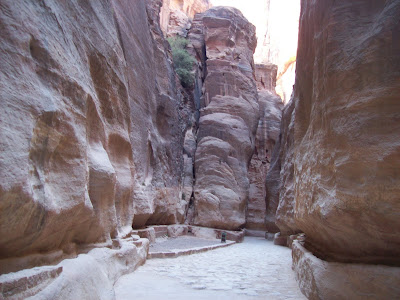
Making our way through the canyon was an unforgettable experience. The cobblestone street meandered through the natural curves of the canyon wall, opening up into large squares before constricting back into narrow causeways. All around the towering pink sandstone sheltered us from the sun, while putting on a fantastic display of color and form, swirling formations mellenia old. Before long, we found ourselves approaching the Treasury Building, the most famous facade of the ancient world, and the poster image of Petra. Eliot, Devin, and I, abandoning the pretence of "cool", burst into spontaneous semi-harmonic "song" during the approach, a spectacle that I was lucky enough to capture on video...


Goofy-ness aside, it really was spectacular. The state of preservation is outstanding, and the facade is such a unique structure, carved as it is, a relief on a grand scale, into the rose red rock of the canyon. The enigmatic building, identified in modern times as the Treasury, has stood for hundreds of years in one of the largest openings in the canyon. Our efforts to enter the building - and extract the Grail we were all sure was inside - were thwarted not by three tests of faith, but rather a sturdy fence and a public presence. Instead, we carried on further into the ancient city.

Outside the Treasury

Most people, previously myself included, are unaware that there is anything more to Petra than its long canyon and famous facade. However, this is truly a lost city, stretching for kilometers around in various states of preservation. Those who lived here, the Nabateans, were tent dwellers, but they carved their public buildings and tombs into every crevice available in the rugged terrain.

More of Petra.

Some of the less beautiful tombs cut deep into the rock to appear as though they were free-standing.

Before the midday heat set in, the three of us decided it would be a good idea to climb up to the central heights of the city. Here, on top of the mountain, ancient animal sacrifices were carried out against the spectacular backdrop of the surrounding scenery. Today, it is important to be sure that you follow the correct trail to the summit, as tourists have gotten lost and died in the unforgiving desert heat. We actually managed to lose the poorly-marked trail for a while, before being recalled to it by a helpful Bedouin women. Our ascent was easy enough, broken by a small lunch, and the view from the top was quite impressive. The rock formations in the area are spectacular, their wavy disorder contrasting artistically with the precision form of the structures carved into them.

Running around on the rock formations.

Leaving the heat of the summit behind, we descended back the way we had come, returning to the town center. From there we headed up the valley wall, following ancient stone staircases through the tombs of the Nabateans. We explored through the ruins, making our way higher and deeper into the valley wall. Eventually we came to a secluded spot, hidden from the valley floor where we rested and ate a relaxed lunch.

The area of our exploration.

The largest tomb in Petra.

Having finished our meal, and watched as some rather large wasps carried off some of kernels of corn that we dropped during lunch. We decided to explore farther into the valley, going off the trail where the sandstone steps had dissolved away centuries ago. After passing some mountain goats, we suddenly found ourselves on top of one of the larger tombs in the area, able to look out over the city center from above.

Giant wasps carrying off corn.

We lingered on top, taking in the view and waving at tourists and touts down below, before carefully descending the rocky face of the valley wall down to a small plateau. The plateau, difficult to access from the valley floor, offered a wealth of interesting tombs and buildings to explore, and Eliot, Devin, and I spent half an hour indulging our curiosities.

The swirling sandstone formations.

Light beaming through a hole in the ceiling of a tomb.

Finally, we climbed down from the plateau to the valley floor below, where we reviewed a map of the area to plan out our remaining time. We still had yet to visit the Monastery, Petra's second most famous building, which exists in a state of preservation similar to the Treasury. However, the Monastery was a two hour round-trip climb through the desert and up a small mountain, and so the prospect was a little more daunting. Refusing to miss anything so spectacular, the three of us began our hike out of the city center and toward Monastery. The climb was admittedly difficult. Under ordinary circumstances, it would not have been so bad, but we were double-timing it up the mountain, having already spent the entire day hiking through the desert, and the heat continued to be unforgiving. Nevertheless, the view that greeted us at the end of our climb made its difficulties worthwhile, as the Monastery loomed out at us, large and magnificent.

Fitting the profile.

The Monastery (note the figure in the doorway for scale).

The Monastery was fantastic. While not as famous as the image of the Treasury, it is nearly as well preserved, and slightly larger. Inside its carved-out great room are some of the best acoustics I've ever come across. After the three of us spent some time investigating the site and catching our breath, we decided to follow up on reports of a spectacular view farther up the mountain. Climbing up the trail, we came across a rather interesting sign...

The view from the end of the world.

Such an invitation is impossible for the curious mind to pass up, and seriously intrigued, the three of us headed up the path toward the End of the World. When we finally made it to the point where the trail terminated at the ledge of a ravine, the sign had lived up to its claim. Nothing was alive in this vast and desolate landscape, which stretched out over rocky outcropings as far as the eye could see. But for the familiarity of the far away horizion, one could easily believe that the earth simply fell away at this god-forsaken place.

Bedouin camps along the edge of the end of the world.

Eliot decided that he would be staying at the end of the world to take in the aproaching sunset, while I professed an interest in seeing the canyon and Treasury again during the daylight. With Devin coming with me, the two of us agreed to meet up with Eliot at the secluded spot we had eaten lunch, and Devin and I began our decent. It was much easier going down, and as we made our way off the mountain and into the city center, the sun was already hanging low in the horizon. In this diminished light, the pink and gold hues of the rock shown more vividly, assuming unnaturally beautiful colors. We made it to the Treasury with time to spare, and I will never forget the expiriance of lingering on a rocky outcropping and just taking in the sight of this famous building.

Taking a look at the famous facade.

After a while, Devin and I left the Treasury behind, and made our way back up to the prearanged meeting spot. Arriving there early, we decided to explore the area a little more thuroughly, finding a series of stone steps that took us higher up into the valley. We sat down on top of an outcropping overlooking the city and watched as the sun slipped beneath the rocks and sand. Our outcropping had a vein of the most vibrantly purple sandstone I've ever come across, and extracting a pebble from this vein I came the closest I ever have to fulfilling a childhood ambition of finding a purble pebble.

The purple pepple.

The sun setting over the ancient city.

We spotted Eliot making his way back from the end of the world, and so Devin and I climbed down to our meeting point where all three of us were soon reunited. We feasted on our remaining provisions, stuffing ourselves to avoid wasting any food. By the time the meal was over, the sunlight had been replaced by the brilliant white light of the full moon. Visitors are encouraged to leave Petra before the sunset, but we had elected to ignore this encouragement in order to enjoy this magnificant site during the full moon. Also, tonight there was a nighttime viewing of the Treasury, complete with a small performance, and by staying inside the site we avoided paying readmission. Instead, we carefully made our way from our hideout down to the valley floor, where we walked by moonlight halfway out of Petra. We hid ourselves in a small crevace ajacent to the main thuroughfare, down which visitors soon began walkng. We slipped into their procession, and followed them back down to the Treasury. Our path was illuminated by paper lanterns, marking the edges of the canyon with a surreal beauty. When we finally made it back to the Treasury, we found that hundreds of these paper lanters, dimly illuminating the square.

Nothing more than a candle inside a sand bag, but if you put a couple hundred of them together the effect is quite spectacular.

We were served a small glass of some of the best tea I've ever had, and the short performance followed. First we listen to a song on a Bedouin gutair, a single-stringed instrument with remarkable range. Then a flutest began a soft song from inside the Treasury. It was a nice show, though rather short, and all three of us were quite happy that we did not pay readmission. Nevertheless, as we remarked to each other as we followed the illumated path out of the ancient city, staying until night was a fantastic idea, and everyone had a great time. We finally stepped outside the city more than 14 hours after entering, quite literally spending our entire day within its awe inspiring confines.

Friday, September 4, 2009

a grail quest


11:09 2 September, East Delta bus to Taba

Today I'm celebrating the four month (one semester) anniversary of my college graduation by embarking on an unplanned adventure. I am still traveling with Devin, and we've picked up a Californian named Eliot for next two days, so I have travel companions. Aside from the fact that such companions will ensure that I won't die alone, they also help to keep the trip more affordable. I suppose it's only appropriate to reveal the details of the adventure, so that further posts are easier to follow...

Step One: Take a bus from Dahab to Taba near the boarder of Israel.
Step Two: Catch a taxi across the boarder into Eliat.
Step Three: Walk across the Israeli Frontier to the boarder of Jordan
Step Four: Cross into Jordan and catch a cab to Aqaba
Step Five: Catch a bus from Aqaba to the fabled lost city of Petra

We'll be staying two nights in Petra, which promises to be one of the most dramatic experiences of an already life-changing trip. I hadn't planned on visiting Jordan, but because we're so close to one of the New Seven Wonders of the World, I couldn't pass it up. And the adventure goes further and farther after we leave Petra. I'll say goodbye to Devin in Jordan, as he has to undergo forty consecutive hours of travel in order to go straight from Petra back home to Oregon, and get myself to Jerusalem. There I'll be staying with my friend Micaela, who has just moved into the city she'll be living in for the next year. I spend two, maybe three, days in Jerusalem before making my way back to Egypt where I'll have a little less than a week to wrap things up before flying out to the United Arab Emirates.

I hope this has provided a good overview of my upcoming travels, and I'll be filling in the details as I'm able over the next week.


10:54 4 September, Internet Cafe in Eilot

I have just made it back from Jordan after a truly awe-inspiring visit to Petra. I don't have time to elaborate, or to upload many photos right now, but I wanted to leave you all with a few teasers of my expiriances in Petra...

Approaching the ancient world's most famous facade...

...and heading in.

Tuesday, September 1, 2009

fifteen (crash) ten commandments

Devin and I have made it back from out early morning climb of Mt. Sinai. At 23:00, a man hurried us into one of the more uncomfortable minibuses I've yet experienced in Egypt (which is saying something) and after picking up some addition climbers and writing down our passport information for the security checks, we were speeding inland. Forget burning bushes and stone-etched commandments, the greatest miracle associated with Mt. Sinai is that I managed to fall asleep for two hours crammed into our overcrowded minibus. I woke up at the security checkpoint, where we were asked to present our passports. Reaching into my pocket, I experienced the bone-chilling sensation of realizing that my passport was not where I thought it was. It would take five semi-frantic minutes of searching, during which the guards were preoccupied with one of the British passengers who had actually left his passport behind, but I found that it had slipped out of my pocket and under the seat in front of me. When I went to present it to the guard however, I initiated a three stooges-esque exchange during which the guards, interpreting the passport as belonging to the British guy, started to ask all kinds of questions, gradually getting themselves more confused until they simply waved me off.

When we finally made it though the checkpoint, it was only another 15 minutes to Mt. Sinai, and we were soon offloaded into the darkened parking lot. I went through a bit more confusion with security personal who, while checking our bags, came across my UV-light water sterilizer. The guards initially interpreted it to be some manner of death ray, but failing to vaporize each other with it, they waved me by and I met up with our Bedouin guide for the midnight hike up the mountain. The stars were fantastic, and I saw more shooting stars in the four hours before dawn broke than I've seen in the last four years. The climb itself was uneventful. It was perhaps the easiest ascent I've ever undertaken, with frequent breaks along a lightly-sloping, albeit long, path. We were at the summit within three hours, and after hunkering down on a flat rock, isolated from the rest of the summit, we sat waiting for dawn.

The predawn hours.

Our group, waiting for sunrise.

The wait would last just over an hour, as the stars faded away and the sky gradually grew lighter. Finally, the sun crept up over the horizon, casting the crevices of the mountians into startling definition. Everything was so beautiful that I found myself taking photographs like mad. Devin and I traded off the camera, capturing some pretty impressive shots in the early morning light.

Sunrise on Mt. Sinai.

Mt. Saint Catherine, the largest mountain in Egypt.

My well-established victory pose upon the successful ascent of a mountain.

The landscape was breathtaking.

The victory pose, on a much grander scale.

After lingering on the summit for an hour or so, our group began the decent down the 3,750 cut stone steps of the Steps of Repentance. We passed by some more pretty remarkable scenery on our way down to the Monastery of St. Catherine, situated at the base of Mt. Sinai. For the first time in my life, I found that the decent was harder than the accent, simply because we were restricted in our speed and we were climbing down a staircase, rather than a mountain face. By the time I reached step 3,749 my legs were pretty wobbly and I truly felt quite repentant for the wrongs I had committed against my knees.

A chapel at the summit, which is a part of the monastic complex.

Making our way down the steps.

Few trees punctuated the landscape, but those that did stood out all the more for it.

The monastery at the base was constructed and fortified by the Byzantine Emperor Justinian in the 6th century. Traces of this famous emperor, as well as his wife Theodra, can be found in the Greek inscriptions written into the door frame, still serving as an entry point to the main chapel. The chapel itself is one of the earliest surviving Christian churches still in existence and operation. Decorated by generations of iconodouls, the chapel is overflowing with golden icons, and ceremonial chandeliers. The monastery has two other highlights, both relating to Moses. The first is the well of Moses, which the prophet is said to have struck from the ground after his meeting with the Holy Spirit in the Burning Bush. The second is the descendant of this famous bush, transplanted in the fifteenth century and still thriving.

The bell tower of St. Catherine's.

Now a days, the Well of Moses is accessed by a crank pump, but it still seems miraculous that any amount of water could be pulled from this barren landscape.

The descendant of the Burning Bush, this 600 year-old shrubbery commands respect.

Overall, the experience of visiting Sinai was fantastic, despite its effects on my sleep schedule. I'm making an effort to keep from napping during the day today, that I might go to sleep slightly early and wake to a restored circadian cycle. This is especially important because my furtive plans for adventure, mentioned in my last update, seem to be developing nicely. I'm keeping this a surprise, but if everything goes well, it will be a good one.